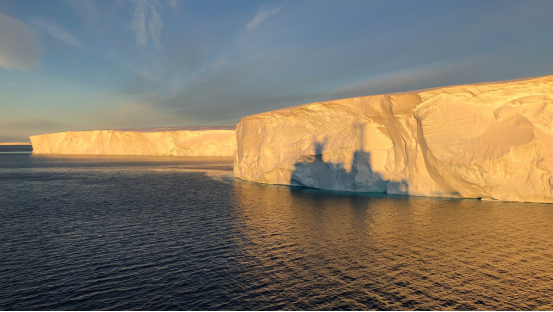
Thwaites Glacier in West Antarctica has been dubbed the “Doomsday Glacier” by scientists due to its potential instability and significant impact on global sea level rise. The glacier, covering approximately 120,000 square kilometers, is melting at a rate that, combined with dynamic changes beneath the ice shelf, could cause significant global sea level rise, threatening coastal cities and low-lying areas.
Scientists are urgently investigating the glacier’s melting mechanisms through satellite monitoring, glacier drilling, and the exploration of subglacial terrain by robotic buoys and submersibles. This research aims to provide crucial data for global sea level predictions. The study of Thwaites Glacier is not only a matter of scientific exploration, but also crucial for the urgent global response to climate change.
1. Geographical and Environmental Background of the Thwaites Glacier
Thwaites Glacier, located in West Antarctica, directly borders the Amundsen Sea and is one of the most unstable parts of the West Antarctic Ice Sheet:
Massive : Glaciers can be up to 2,000 meters thick, with a total volume sufficient to raise global sea levels by approximately 65 centimeters;
Fast flow : The speed of the glacier’s end flowing toward the ocean is accelerating, transporting a large amount of ice into the sea every year;
Weak ice shelves : The floating ice shelves that connect glaciers to the ocean are breaking up at an accelerated rate, making the glaciers less stable;
Climate sensitivity : The intrusion of warm Antarctic ocean currents accelerates the melting of glacier bases and increases the risk of collapse.
These characteristics have made Thwaites Glacier a focus of global climate science attention.
2. The origin of the title “Doomsday Glacier”
Thwaites Glacier has been dubbed the “Doomsday Glacier” not only because of its potential impact but also because of the risks of rapid change revealed by research:
Sea level contribution : If Thwaites Glacier and the surrounding ice sheets fail completely, it could cause global sea level rise of more than 3 meters within a few hundred years;
Chain reaction : Glacier collapse could trigger the destabilization of other glaciers in West Antarctica, forming an irreversible melt chain;
Social impacts : Coastal cities worldwide face risks of flooding, land loss, and economic losses.
This symbolic name of “Doomsday” reminds the scientific community and the public of the urgency of studying glacier stability.
3. Scientific Research Mission and Technical Means
Scientists have launched a series of international joint missions to study Thwaites Glacier in depth:
Satellite and remote sensing technology
Monitoring glacier surface changes using radar and laser altimetry;
Detect glacier flow rates, crevasses, and meltwater pathways.
Under-ice detection
mapping the sub-ice terrain using autonomous submersibles and sonar systems;
Analyze the interaction between the glacier base and seawater to understand the melting mechanism.
Glacier drilling
Drilling ice cores and subglacial sediments to reconstruct historical melt and sedimentation records;
Obtain paleoclimate information and predict the response of glaciers to climate change.
Numerical modeling
The observational data are fed into glacier dynamic models to simulate future melting trends and sea level impacts;
Provide scientific basis for policymakers and guide response strategies.
The combined use of these technical means enables scientists to obtain high-precision data in extreme environments and reveal the laws of glacier evolution.
4. Environmental and Climate Background
Changes in Thwaites Glacier are influenced by a variety of environmental factors:
Rising sea temperatures : The intrusion of warm ocean currents from the Amundsen Sea accelerates the melting of the glacier base;
Rising temperatures : Summer temperatures in West Antarctica are rising, increasing the amount of meltwater on the glaciers;
Ice shelf fragmentation : The breaking of floating ice shelves causes glaciers to lose support and accelerate their flow;
Polar wind and precipitation changes : Changes in wind and snowfall affect glacier mass balance.
Understanding the interplay of these factors is key to predicting glacier stability and global sea level change.
5. Global Sea Level Impact
The potential collapse of Thwaites Glacier has profound implications for coastal regions around the world:
Coastal city risks : New York, Mumbai, Tokyo, and the New York Bay area face flooding threats;
Economic losses : Coastal infrastructure, real estate, and agriculture have been severely impacted;
Ecosystem impacts : Seawater intrusion into freshwater ecosystems threatens biodiversity;
Society and migration : Coastal residents may be forced to migrate, increasing socioeconomic pressures.
Scientists predict through models that glacier instability may have a significant impact in the next 200-500 years, but the specific time remains uncertain.
6. International Cooperation and Research Team
The Thwaites Glacier Study is a multinational collaboration:
Participating countries : The United States, the United Kingdom, Germany, Australia and other scientific research institutions jointly act;
Multidisciplinary team : including glaciologists, oceanographers, climatologists, engineers and technical experts;
Data sharing : Global scientific teams share observational and model data to improve forecast accuracy;
Remote technology applications : Unmanned submersibles, satellite monitoring, and autonomous buoys reduce human exposure risks in extreme environments.
International cooperation not only improves scientific research efficiency, but also ensures the comprehensiveness and comparability of data.
7. Challenges and Future Directions
Studying Thwaites Glacier presents many difficulties:
Extreme environments : strong winds, low temperatures, and ice cracks increase the risk of field operations;
Data uncertainty : The subglacial terrain is complex, and model predictions still contain errors;
Long-term monitoring needs : Glaciers change slowly and continuously, requiring continuous observation and long-term data accumulation;
Policy and action lag : There is a time lag between scientific discoveries and global emission reduction and adaptation measures.
In the future, by combining long-term satellite monitoring, automated detection and global climate models, scientists will further improve glacier prediction capabilities and provide scientific support for coastal risk management.
8. Conclusion: Glaciers as a Warning
The study of Thwaites Glacier reminds us that Earth’s polar environment has a significant impact on global climate. The scientists’ “Glacier Doomsday” mission is not only an exploration of glacier dynamics but also a warning about future global sea levels and ecological security.
Small changes in glaciers can trigger chain reactions, impacting the living environment of hundreds of millions of people worldwide. Understanding, monitoring, and taking scientifically-driven action are crucial responsibilities for humanity in the face of the climate crisis .
The story of Thwaites Glacier is both a scientific legend of polar exploration and a global ecological wake-up call, reminding us that every climate decision is closely linked to the future of the Earth.