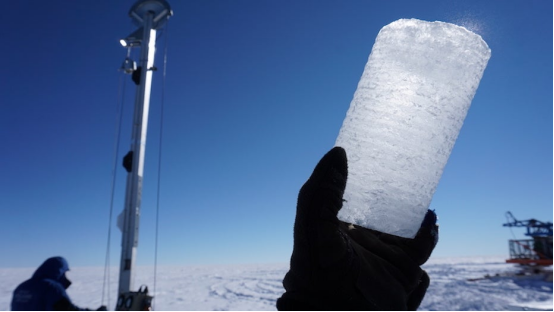
Polar ice core research is a crucial frontier in climate science. Ice cores, as the name suggests, are cylindrical ice samples drilled from the Antarctic and Arctic ice sheets. They record information about Earth’s environment spanning thousands to tens of thousands of years. By analyzing these ice cores, scientists can reconstruct paleoclimate, track greenhouse gas fluctuations, and understand the long-term evolution of Earth’s climate system. Polar ice cores not only reveal historical climate fluctuations but also provide a scientific basis for predicting future climate change.
The allure of ice core research lies in its precision and breadth: Each layer of ice acts as a natural archive, recording traces of temperature, snowfall, volcanic eruptions, aerosol concentrations, and even human industrial emissions. This information allows scientists to glimpse Earth’s climate events thousands of years ago and compare them with modern climate change trends.
1. Ice core formation and recording mechanism
The annual accumulation of snow from the polar ice caps gradually compacts and forms ice sheets. This process makes ice cores natural time capsules:
Annual ring structure : Each year’s snowfall forms distinct layers, similar to tree rings, which can be used for dating;
Bubble record : Bubbles trapped in ice preserve the composition of the ancient atmosphere, including the ratios of carbon dioxide, methane, and oxygen;
Aerosols and microparticles : Wind-blown dust, volcanic ash, and sea salt particles are trapped, providing evidence of volcanic eruptions and storm events;
Isotope variations : Oxygen isotope ratios reflect the temperature conditions of the year and can be used to reconstruct climate fluctuations.
These physical and chemical characteristics make ice cores high-precision climate archives.
2. Ice Core Drilling Technology and Challenges
Drilling ice cores is not an easy task and requires complex techniques and rigorous operations:
drilling equipment
Extract ice cores from the surface of the ice sheet to depths of thousands of meters using thermal or mechanical drills;
Ensure ice core integrity and avoid contamination or melting.
Field conditions
Extreme cold temperatures, storms, and ice cracks increase drilling difficulties;
Remote camps require stable energy and communication guarantees.
Sample transportation and storage
Ice cores must be transported to the laboratory at a low temperature;
Avoid melting and contamination, ensuring analytical accuracy.
Ice core drilling is a technology-intensive and high-risk task in polar science, which places high demands on the physical, technical and organizational capabilities of the scientific research team.
3. Decoding Climate History
Ice cores provide information that can be used to reconstruct Earth’s climate history, including:
Glacial and interglacial periods : Scientists identify temperature fluctuations and cycles during glacial and interglacial periods through changes in gas concentrations and isotopes;
Volcanic Eruptions and Environmental Impacts : Aerosol and ash records reveal the long-term effects of large-scale eruptions on temperature and precipitation;
Solar activity and climate : Sunspot cycles and cosmic ray variations are reflected in ice cores through isotope signals;
Traces of human activity : Since the Industrial Revolution, carbon dioxide, sulfates and other pollutants have been sequestered, providing a basis for studying the impact of humans on the climate.
These data help scientists understand the relative contributions of natural and human factors to climate change.
4. Comparison of Arctic and Antarctic Ice Cores
The ice cores from the Antarctic and Arctic have their own unique characteristics, which complement each other:
Antarctic ice core
Thickness can reach several thousand meters, and the record period exceeds 800,000 years;
Providing global climate change data on long time scales.
Greenland ice core
It is about 3,000 meters thick and has a record time of about 120,000 years;
More sensitive to changes in Northern Hemisphere climate events, storms and glacier melt.
By comparing polar ice cores, scientists can analyze regional differences and interactions in the global climate system.
5. Ice Core Research and Modern Climate Science
Ice core research provides key foundations for modern climate science:
Predicting climate change trends : Building climate models by comparing past climate patterns and greenhouse gas concentrations;
Assessing climate sensitivity : analyzing the response of temperature and precipitation patterns to increasing greenhouse gases;
Verifying the effectiveness of global climate policies : comparing changes in gas concentrations before and after industrialization to assess the effectiveness of emission reduction policies;
Extreme event research : volcanic, storm, and drought events recorded in ice cores provide a reference for modern extreme climate warnings.
Ice core research has enabled climate science to shift from qualitative description to quantitative analysis, providing scientific support for global response to climate change.
6. Scientific Research and Technological Innovation
Modern ice core research relies on multidisciplinary technologies and innovations:
Isotope analysis : High-precision instruments measure oxygen and hydrogen isotope ratios to accurately reconstruct temperature history;
Trace gas detection : measuring trace greenhouse gas concentrations in ice through mass spectrometry;
High-resolution scanning : can identify annual and even seasonal climate change signals;
Digital modeling and data sharing : Global research teams conduct comprehensive analysis of ice core data through data sharing and model simulation.
Technological advances have expanded ice core research from local surveys to an important tool for global-scale climate science.
7. Environment and Global Significance
The information revealed by ice cores is not only of academic value, but also has far-reaching social and policy significance:
Global climate policy guidance : providing data support for greenhouse gas emission reduction, carbon emission monitoring and sustainable development;
Polar protection : revealing ice sheet stability and glacier melt risks, guiding environmental protection actions;
Public education and awareness raising : Ice core research stories help the public understand the science and urgency of climate change.
Ice core science has made the polar regions not only the coldest regions on Earth, but also an important reference for global climate understanding and action.
8. Conclusion: Time Capsules in Ice Cores
Polar ice cores are a silent historical record, preserving Earth’s climate past and illuminating its future. By decoding ice core data, scientists can track climate fluctuations over millennia, understand the interplay between natural and human factors, and provide a basis for addressing modern climate challenges.
Ice core research reminds us that humans have a profound impact on the climate, and that scientific observation and global cooperation are key to addressing climate change . The polar ice caps are not only an extreme challenge for explorers, but also an archive of Earth’s climate that scientists and policymakers share.